
There’s a specific moment I’ve watched play out thousands of times in conversation data. User opens your AI product. Tries to get something done. The AI gives them something back, but not quite what they needed. Maybe it was vague. Maybe it was confidently wrong. Maybe it just didn’t solve the problem.
The user doesn’t rage-quit. They don’t leave a bad review. They don’t even feel particularly frustrated, because they’ve already given the AI the benefit of the doubt in their head. They think: “I’m probably not phrasing this right. I’ll try again when I have more time to think about it.”
And then they close the tab.
That thought is the last thing that happens before a huge percentage of your users churn. And you probably have no idea when it’s happening.
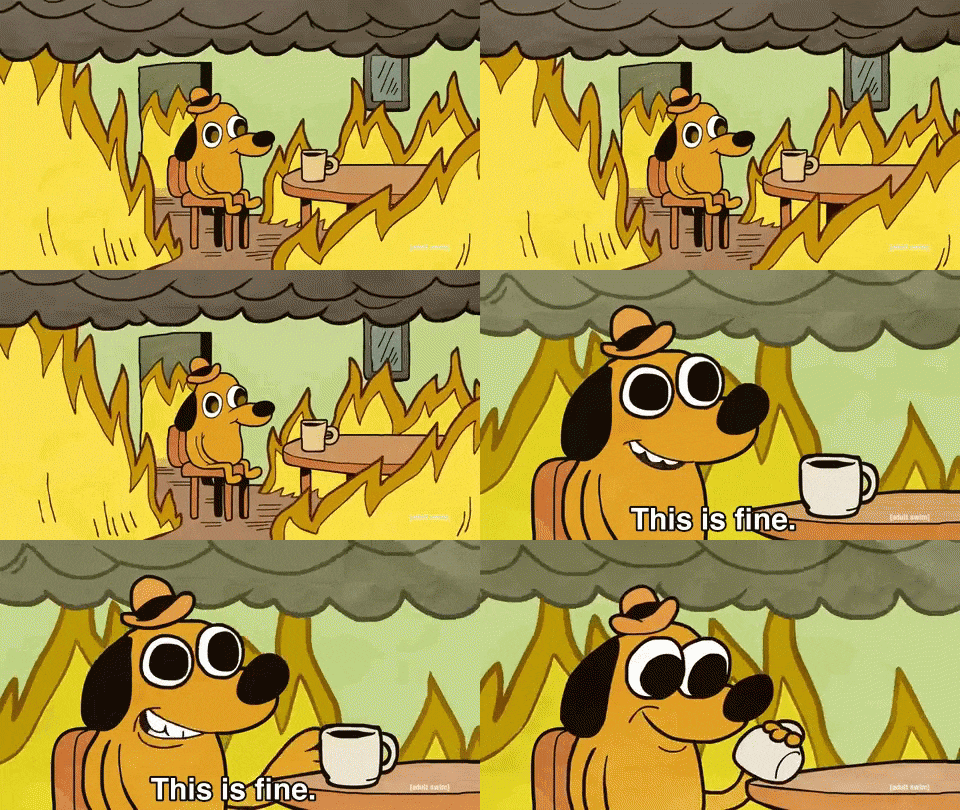
^ your retention dashboard the week 40% of your “active users” quietly decided to come back “later”
Why “I’ll try again later” is more dangerous than a rage-quit
Here’s the thing that took us a while to fully internalize at Agnost: the angry user is actually easier to handle.
An angry user knows they’re done. They made a decision. You can see it in the data, sometimes they’ll even tell you why, and there’s nothing ambiguous about the outcome. The churn is clean.
The “I’ll try again later” user is in a completely different psychological state. They’re not done. They’re just pausing. In their mind, they’re still a user of your product, just a user who needs better conditions to succeed with it. This is what makes them invisible in your metrics. They didn’t churn, they deferred. And your analytics treats deferred churn exactly the same as a normal session end.
But here’s what makes it dangerous: the hope is fragile.
The user closes the tab with a genuinely positive disposition toward your product. They’ll try again. They mean it. But “later” is not a scheduled event. It’s a vague intention, and vague intentions decay fast. The longer the gap between that session and the next one, the less that optimistic framing holds. Life fills the space. The context they were building up mentally fades. And eventually, “later” just quietly becomes “never”, without any conscious decision being made.
The longer the gap, the less likely they come back. That’s not an opinion. Across the conversation data we process at Agnost, users who exit in an “I’ll try again later” pattern and dont return within 48 hours have dramatically lower 30-day retention than users who left a completed session and came back at any point. The 48-hour window is real. After 72 hours, return probability drops sharply. After 7 days, you’ve essentially lost them.
Your re-engagement window for these users isn’t a week. Its 24-48 hours.
What this actually looks like in your session data
You can’t grep for “I’ll try again later.” But you can spot the behavioral signature.
There are three specific patterns that correlate with this mental state:
The mid-session abandon. User is in an active conversation, gets a response, and the session ends, not at a natural endpoint, but mid-thread. No wrap-up message, no “thanks,” no signal that the user got what they needed. The conversation just stops. This is the most common version. The user hit a wall they didn’t want to deal with in the moment and walked away.
The polite exit after a failed response. User gets an answer that doesn’t work for them. Instead of pushing back or rephrasing, they say something like “ok thanks” or “I’ll think about it” and close. If this happens at turn 3 of what should have been a 10-turn conversation, it’s not resolution. It’s resignation dressed up as politeness. The key signal is the turn depth: a polite exit at turn 3 means something went wrong early and the user didn’t have the energy to fix it.
The same-day restart. User closes the app, comes back within a few hours, and starts a new session trying to accomplish the same thing differently. This one is actually the most telling. The user tried again, which means they still believed. But they restarted fresh instead of continuing, which means the first attempt was so unsuccessful they didn’t even want to build on it.
All three of these look completely normal in a standard event log. “Session ended. Session started.” No alarm bells. But in aggregate, these are the sessions that are quietly draining your retention numbers.

^ you, trying to figure out why 30-day retention is declining when every session looks “normal” in your logs
The 3 triggers that create this moment
Not every “I’ll try again later” session is the same kind of failure. There are three root causes, and only one of them is benign.
Trigger 1: The incomplete answer. The AI gave the user something useful but didn’t actually solve the problem. Maybe it addressed half the question. Maybe the answer was directionally right but too generic to be actionable. The user can see that more context might help, so they tell themselves they’ll come back with a better prompt. This is a product failure dressed up as user behavior. The AI should have either solved the problem or asked the right clarifying question to get there.
Trigger 2: The confidence mismatch. The AI answered with full confidence. But the user suspects it’s wrong, or at least suspects they can’t verify it fast enough to use it. So they close the tab to check elsewhere and never come back. This is also a product failure. Confidently wrong answers are worse than uncertain ones. Users who get burned by confident AI answers dont always blame the AI, but they stop trusting it. And a product they don’t trust is a product they visit less.
Trigger 3: The context overload. The problem the user brought was genuinely too complex for the session. They needed to think more before continuing. This is the only healthy version of “I’ll try again later.” The user wasn’t failed by the AI. They arrived at a limit of their own readiness.
Here’s the uncomfortable part: triggers 1 and 2 probably account for the majority of your “I’ll try again later” sessions. Trigger 3 is real but rare. If you’re seeing this pattern at scale, you have an AI quality problem showing up as a user behavior pattern.
The return rate cliff (and why your re-engagement playbook is probably calibrated wrong)
Most re-engagement campaigns are set up with weekly or bi-weekly cadences. Someone hasn’t opened the app in 7 days, send them a push notification. 14 days, send an email. That timing made sense for apps built around habits that naturally operate on weekly rhythms.
For AI products, and specifically for users who left in an “I’ll try again later” state, those timelines are far too slow.
Based on what we see at Agnost: if a user exits with this abandonment pattern and doesn’t return within 48 hours, return probability drops sharply. By 72 hours, it’s significantly lower than users who had completed sessions. By 7 days, the “later” has effectively become “never.” Not because they made a decision to leave. The decision was made for them by time and inertia.
The re-engagement window is 24-48 hours.
A push notification at 7 days is reaching a user who, in their own mental model, hasn’t been gone for long (they were always planning to come back, remember?) but whose context, motivation, and connection to your product has fully cooled. You’re not re-engaging them, you’re starting over.
A context-aware nudge at 18 hours, one that references what they were actually trying to do, hits them while the session is still fresh and the intention is still alive.
This is the difference between an AI product with a re-engagement system and one with a push notification schedule.

^ teams who discover their “re-engagement campaign” has been firing 6 days after the only window that actually works
How to catch and recover these users
Detection first. You need to be flagging these three patterns — mid-session abandons, polite exits at low turn depth, and same-day restarts on the same intent — and tagging them separately from normal session ends. They are not normal. Treating them as normal is how you miss the signal.
Then re-engagement, and this part matters: it has to be context-aware. Not “hey, you haven’t been back in a while.” That’s generic and it doesn’t honor what the user was actually trying to do. The message needs to reference the specifics.
“Hey, last time you were working on [intent type]. Want to pick up where you left off?” That converts. A generic “we miss you” does not. The specificity tells the user that the product actually remembers them, which is exactly the objection they had when they left (“I’ll have to re-explain everything next time anyway”).
And there’s a product fix buried in here too. If a specific intent type is generating “I’ll try again later” abandonment patterns at high rates, the AI isn’t handling that intent well. That’s not a re-engagement problem, that’s a roadmap item. Every cluster of abandonment sessions around a specific intent type is your product telling you where it’s failing.
What the best AI products do differently
The teams who are winning on session abandonment AI metrics aren’t just doing better re-engagement. They’ve changed the product architecture.
Specifically, they’ve built continuation prompts. When a user comes back after an incomplete session, the AI meets them where they left off. Not “hi, how can I help you today?” but “last time we were looking at this, you mentioned [X]. Did you want to continue from there?”
This directly kills the biggest “I’ll try again later” to “actually never mind” conversion factor: the dread of re-explaining context. That dread is huge. Users know, consciously or not, that coming back means rebuilding the context from scratch. It’s friction that makes the “later” feel heavier the longer you wait.
Remove that friction and the physics change. Now “coming back” costs nothing. The context is waiting. And users who leave with an unresolved problem but no context-rebuild tax are much more likely to follow through on that “later.”
This is part of what separates products with 18% D30 retention from products struggling at 8%. Not better AI, not better marketing, just a better understanding of what makes users not come back, and removing it.
If you want to see where these patterns are showing up in your product, Agnost surfaces exactly this: which sessions ended in abandonment, which intent types are generating the pattern, and when the re-engagement window closes per user. It’s the visibility layer that turns “we’re losing users and we don’t know why” into a specific, actionable list of things to fix.
Wrapping it up
“I’ll try again later” is not a soft exit. It’s a churn event with a 48-hour delay.
The users who say it don’t feel like they’re quitting. They feel like they’re pausing. That optimism is real in the moment, and it genuinely gives you a window to get them back. But the window is short and most teams aren’t even watching for it.
The fix isn’t complicated. Detect the pattern. Re-engage fast and specifically. Fix the intent types that are generating the pattern at scale. And remove the context-rebuild friction that makes “later” feel like too much work.
Your product isn’t failing these users in a dramatic way. It’s failing them in the quietest possible way, and they’re being gracious about it. Track the grace period before it expires.

^ you, after setting up abandonment detection and discovering the 48-hour re-engagement window your campaigns were completely missing
TL;DR: “I’ll try again later” is the last thought before churn, not a pause. The re-engagement window is 24-48 hours, not a week. Detect mid-session abandons and polite exits at low turn depth, re-engage with context-aware nudges before the window closes, and fix the intent types generating the pattern at scale.
Reading Time: ~8 min