
A text-first AI assistant is an AI product where the main interface is a written back-and-forth: chat, command messages, support replies, coding prompts, inbox assistants, and internal copilots.
The important part is that the product succeeds or fails inside the conversation. That sounds obvious until you look at how most teams actually measure these products. They track messages sent. Session length. Daily active users. Maybe thumbs up and thumbs down if someone remembered to add the widget. Then they ask why the assistant “feels worse” after a deploy but the dashboard is green.
The answer is usually sitting in failed conversations. The messy transcripts where users rephrase the same request six times, get politely annoyed, accept a bad answer, or quietly disappear.
That is where the product is trying to teach you.
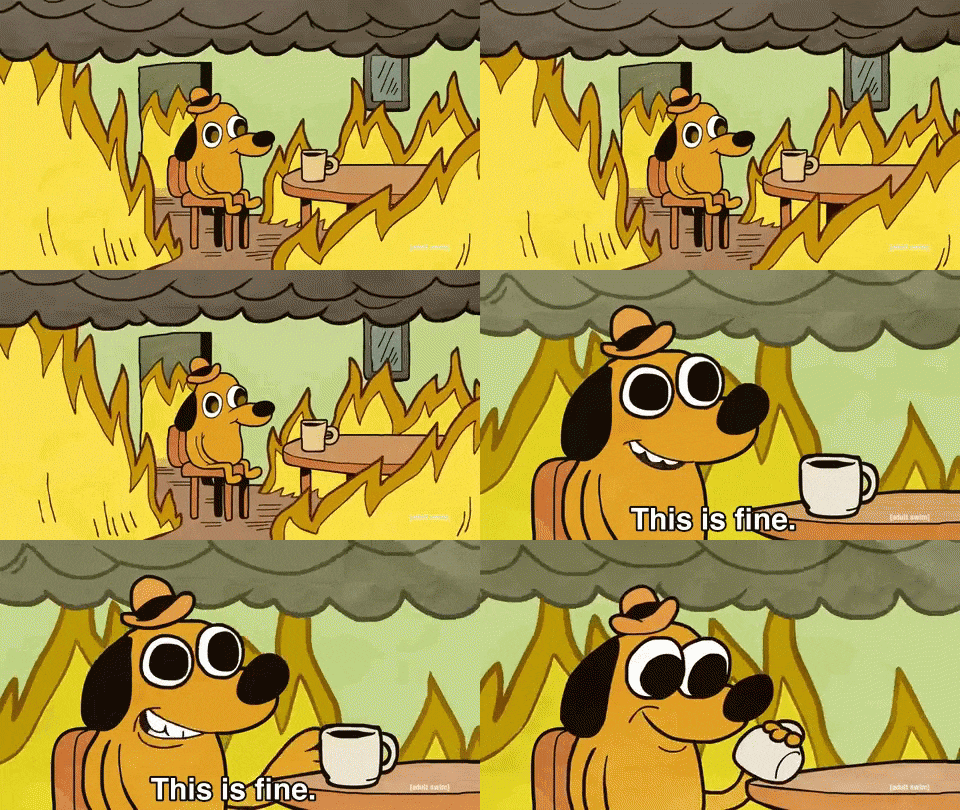
^ your dashboard saying “engagement is up” while users are begging the assistant to understand one normal sentence
Why do failed conversations matter more than successful ones?
Successful conversations are useful, but they mostly tell you what already works.
Failed conversations tell you where the product boundary actually is.
They show the gap between what your assistant claims to do and what users believe it can do. That gap is the real product surface. It is bigger than your nav, bigger than your onboarding, bigger than the feature list on your homepage.
In a text-first assistant, users do not think in your feature taxonomy. They type what they want.
“Can you make this less cringe?”
“Why did the invoice fail?”
“Fix the auth bug.”
“What should I say to this customer?”
Those messages contain intent, context, urgency, emotional temperature, and hidden expectations. When the assistant fails, the failure usually tells you something specific:
| Failure pattern | What it usually means | What to inspect |
|---|---|---|
| User repeats the same ask | The assistant did not understand the intent | Semantic similarity across turns |
| User asks “what do you mean?” | The answer was confusing or too abstract | Prior assistant response |
| User says “no” or “not that” | The assistant optimized for the wrong goal | Intent classification |
| User accepts a weak answer | The assistant sounded plausible enough to end the session | Resolution quality |
| User leaves after a long answer | The response was complete but useless | Response-to-exit timing |
This is why raw completion rate is dangerous. A conversation can end because the user got what they needed. It can also end because they gave up. Same event. Opposite meaning.
What does a failed conversation actually teach you?
The biggest lesson: failure is usually not random. When teams first read transcripts, they treat each bad session like a weird one-off. Cool. Maybe. But once you cluster failures, patterns show up fast.
Lesson 1: Users expose missing product nouns
Your assistant has an internal map of the product. Users have a different one.
They say “workspace” when your product calls it “project.” They say “client” when your CRM says “account.” Failed conversations reveal the nouns users naturally use. That matters because a text-first assistant lives or dies on mapping messy language to the product’s actual objects.
If users keep asking for “the report” and your assistant only knows “dashboard export,” that is not a prompt problem. That is a product vocabulary problem.
Lesson 2: The first wrong turn is usually the expensive one
Most failed conversations do not collapse immediately. They drift. The assistant gives a slightly wrong interpretation on turn 2. The user corrects it. The assistant half-corrects but carries forward the wrong assumption. By turn 7 the conversation is a pile of polite nonsense.
If you only score the final answer, you miss the part that caused the failure.
Track the first divergence. Ask: where did the assistant’s understanding split from the user’s intent? That one turn is often worth more than the whole transcript.

^ the user’s actual intent and the assistant’s confident interpretation, somehow both called “resolved”
Lesson 3: Politeness hides pain
Text makes users nicer than they feel. They type “thanks” when they mean “I am done trying.” They type “ok” when they mean “this is not worth correcting.” They type nothing at all, which is the most expensive feedback you will ever receive.
So you cannot treat pleasant words as satisfaction.
Look at the sequence:
| Ending | Healthy version | Bad version |
|---|---|---|
| “thanks” | After the assistant completes a specific task | After vague advice at turn 3 |
| “got it” | After a clear explanation with follow-up detail | After the user already rephrased twice |
| no reply | After a short factual answer | After a long answer to a high-stakes ask |
Context decides the meaning. The word alone is almost worthless.
How should teams study failed conversations?
Do not start with a 40-metric dashboard. That is how you build a cockpit nobody opens. Start with a weekly failure review.
Pull 50 suspicious conversations. Not random conversations. Specifically suspicious ones:
- Sessions with 3 or more user rephrases
- Sessions ending within 30 seconds of a long assistant response
- Sessions with negative user sentiment
- Sessions where the user asked for clarification twice
- Sessions that ended with a polite exit after a weak answer
Tag each conversation with three labels:
| Label | Question |
|---|---|
| User intent | What was the user actually trying to do? |
| Failure source | Did the assistant misunderstand, lack context, refuse badly, hallucinate, or give useless generic advice? |
| Fix type | Prompt, retrieval, product copy, tool call, model choice, UX, escalation, or new feature? |
The fix type is the part founders skip. They read failures, nod seriously, and then go back to vibes. You need the failure to turn into a product action. Otherwise you are just doing transcript theater, which sounds productive and changes nothing.
Which failed conversations should you fix first?
Not all failures deserve equal attention. Fix the ones that combine frequency, user value, and confidence.
| Priority | Example | Why it matters |
|---|---|---|
| P0 | Paid users fail on a core workflow | Direct churn or revenue leak |
| P1 | New users fail during first useful session | Activation damage |
| P2 | High-volume intent has moderate frustration | Compounds over time |
| P3 | Weird edge case from one power user | Useful, but maybe later |
The painful truth: the loudest transcript is not always the most important transcript. A quiet pattern across 300 conversations is usually more important than one spectacular failure.
This is where a Frustration Index helps. Repetition, clarification requests, negative turns, length drop, and post-response abandonment give you a better prioritization signal than “the user wrote in all caps.”

^ the team discovering that the boring repeated failure costs more than the dramatic support ticket
What should you change after finding the pattern?
The best fix depends on the failure. If the assistant misunderstands user language, improve intent classification and vocabulary mapping. If it lacks product context, fix retrieval or tool access. If it gives correct but useless answers, rewrite the response policy around concrete next steps. If it keeps going when it should stop, add an escalation or clarification rule.
If it hallucinates because the product cannot actually do the thing, change the UX. Do not train the assistant to be more charming about a dead end. That is how you build a very polite failure machine.
The practical loop:
- Find suspicious conversations.
- Cluster by failure pattern.
- Pick the highest value cluster.
- Identify the first wrong turn.
- Ship one targeted fix.
- Watch the same cluster for 7 days.
That last step matters. If the failure pattern does not move after the fix, you did not fix it. You performed a ceremony.
FAQ
Are failed conversations better than evals?
No. Evals catch known risks before shipping. Failed production conversations show unknown risks after real users bring real mess. You need both.
What is the fastest useful metric?
Message repetition rate. If users keep asking the same thing in different words, the assistant is failing in a way your normal analytics probably calls engagement.
TL;DR
Failed conversations are not garbage data. They are the clearest map of where a text-first AI assistant breaks.
Look for repeated intent, clarification loops, polite exits, post-response abandonment, and the first wrong turn. Cluster the failures. Prioritize by impact. Ship targeted fixes and watch whether the pattern actually improves.
Agnost is built around this idea: conversations are not just logs, they are product feedback with timestamps. Use that layer lightly or deeply, but use it. Otherwise your assistant will keep teaching you lessons and you will keep politely ignoring them.
Reading Time: ~8 min